


 Polski
 Deutsch
 Español
 Français
 Italiano
 Nederlands
 Čeština
 Română
 Lietuviškai
 Українська

Permitra • DIWASS • Annex VII instructions
DIWASS instructions: how to submit an Annex VII document step by step
In DIWASS, the Annex VII document is completed by several companies in turn: the person who arranges the shipment, the waste producer, the carrier, the consignee and the facility. See who does what, in which order, and where mistakes happen most often. A detailed cheat sheet with screenshots is available as a free PDF.
- Green-listed waste
- Regulation (EU) 2024/1157, Article 18
- Free PDF guide
In short
Five roles, one shared document
- The person who arranges the shipment creates the document, signs it and submits it no later than 2 working days before the shipment starts.
- The waste producer reviews the document and signs it before it is submitted.
- The carrier confirms taking over the waste.
- The consignee confirms receipt.
- The facility or laboratory confirms receipt and, later, completion of recovery.
Where things stand
The Annex VII module is live
Annex VII documents can be submitted in the production version of DIWASS since 15 November 2026. The European Commission has suggested extending the transition period, so that digital Annex VII documents would become mandatory only from a date after 1 January 2027. It will set out the timeline after discussing this with the Member States. Dates and the transition period.
Before you start: four checks
An Annex VII document can only be created in DIWASS if all parties are in the system. Companies cannot be typed in by hand – they are selected from the list of registered operators.
The company arranging the shipment is registered in DIWASS.
The person filling in the document is authorised in the system to act for that company.
The producer, carrier, consignee and facility are also registered in DIWASS.
4. Country of dispatch. Many countries accept an Annex VII document for a shipment leaving their territory only if the arranger is established there. DIWASS does not check this, so check the rules of the country of dispatch first.
Have this ready before you start
- names or identification numbers of the consignee, carriers, producer and facility (the system suggests companies after three characters),
- the quantity of waste in tonnes or m³ and the departure date,
- the address of the loading site and the container number, if any,
- waste codes (e.g. Basel, OECD, EU List of Waste) and the recovery operation code,
- attachments, e.g. the contract or information on the composition of the waste.
The DIWASS interface is in English. The main buttons are Create, Save, Authenticate (electronic signature) and Submit. The Commission manual does not set a language for the entries; we recommend filling in descriptive fields in English, or in a language the authorities of the countries of dispatch and destination understand.
Who must be registered and where company registrations get stuck is covered in DIWASS from 2027: how to prepare for the new obligations.
Ireland, Northern Ireland and Great Britain
An EU Member State – the EU rules and DIWASS apply as in any other Member State.
The EU Waste Shipment Regulation applies there under the Windsor Framework, so Northern Ireland operators and the competent authority use DIWASS.
England, Scotland and Wales are outside the EU. A company there can be selected in a DIWASS document only if it is registered in DIWASS, even if it never logs in. Using DIWASS is voluntary for companies outside the EU.
For imports into the EU from Great Britain, if the arranger there does not use DIWASS, the EU consignee or facility can enter the document from its own account, on the arranger’s behalf. DIWASS records that it was submitted on behalf of another company.
How the document moves through the system
Every Annex VII document has a status. It changes automatically when the next company completes its step, so the status shows at a glance where the shipment stands.
| Status | What it means | Who can act |
|---|---|---|
| Draft | The document is being prepared. Only the arranger and the producer can see it. | The arranger edits, the producer signs. |
| Announced | The document has been submitted. All parties and the competent authorities can see it. | Until departure, the arranger can change only the quantity, the carrier(s) and the container number. |
| Moving | The first carrier has confirmed taking over the waste. | Carriers, consignee, facility. |
| Received | Receipt of the waste has been confirmed (the Commission’s status table links this to the facility’s reception certificate). | Consignee and facility. |
| Completed | The facility has confirmed completion of recovery. | No one, according to the status table in the Commission manual – although the manual’s facility chapter also describes editing the completion certificate. |
| Cancelled | The arranger cancelled the document in Draft or Announced status. | No one. A cancellation cannot be undone. |
From submission onwards, a competent authority can also require the waste to be taken back (Take-Back status).
Person who arranges the shipment: creating and submitting the document
The arranger prepares the whole document and is responsible for it. It takes five steps.
- Create the document. In the Documents menu choose the Annex VII module, click Create, select your company and the countries of dispatch, transit and destination.
- Save the draft. When you click Save, the system assigns a document number.
- Complete the boxes. Consignee, quantity, departure date, carriers, producer, loading site, facility, operation code, description and waste codes – in any order.
- Sign. Click Authenticate, then wait for the producer’s signature.
- Submit. After Submit, the status changes to Announced and the document reaches the other parties and the authorities.
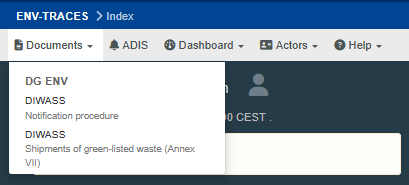
The arranger completes the Annex VII document no later than two working days before the shipment starts (Article 18(5) of Regulation 2024/1157). DIWASS will not accept a departure date on the day of submission or the next day, but the law requires two full working days – weekends and public holidays do not count. The quantity, carrier(s) and container number can still be provided or changed until the shipment starts.
The arranging company and the countries cannot be changed once the document has been created – a mistake means starting a new document. The box-by-box cheat sheet is in the free PDF guide.
Waste producer: review and signature
If the arranger is not also the waste producer, the producer is named in the document. The producer can see the document from the draft stage. It can only read and sign it (Authenticate) – it cannot change anything.
Any change removes the signature. If the arranger changes anything after the producer has signed, the system removes that signature and the producer must sign again. The document cannot be submitted without the signatures of all producers.
Carrier: confirming that the waste has been taken over
The carrier can see the document once it has been submitted. When taking over the waste, the carrier fills in a transfer confirmation on its own line: the date of transfer and the means of transport, with an optional attachment, and then signs it. The first such confirmation changes the status to Moving.
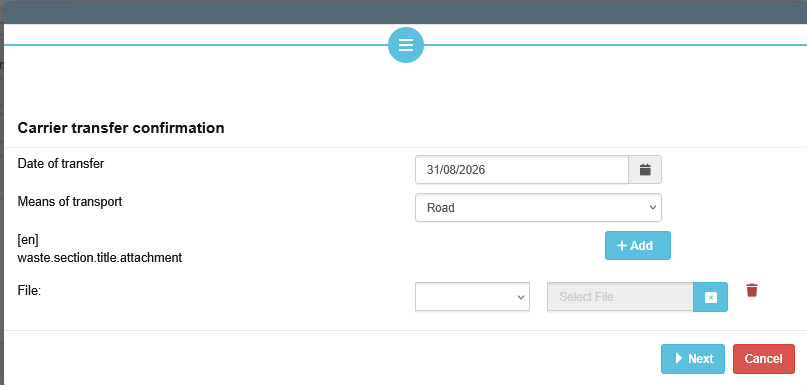
With several carriers, each confirms its own leg separately. A carrier corrects its own confirmation and signs it again. Carriers see only some of the document’s attachments (e.g. waste composition or route), so the arranger should label every attachment correctly.
Consignee: confirming receipt
After delivery, the consignee (importer) enters the date of receipt in the document, with an optional attachment, and signs the confirmation. It then appears in box 13 of the document. Article 18 does not set a separate deadline for this confirmation.
Facility or laboratory: receipt and completion of recovery
The facility submits two certificates, both signed.
Date of receipt, quantity accepted and rejected, reason for rejection and composition of the waste received. Due within 2 working days of receipt (Article 18(8)). The status becomes Received.
Completion date and the quantities prepared for re-use or recycled and recovered in another way. Due as soon as possible, no later than 30 days after completion of recovery and no later than one year after receipt (Article 18(9)). The status becomes Completed.
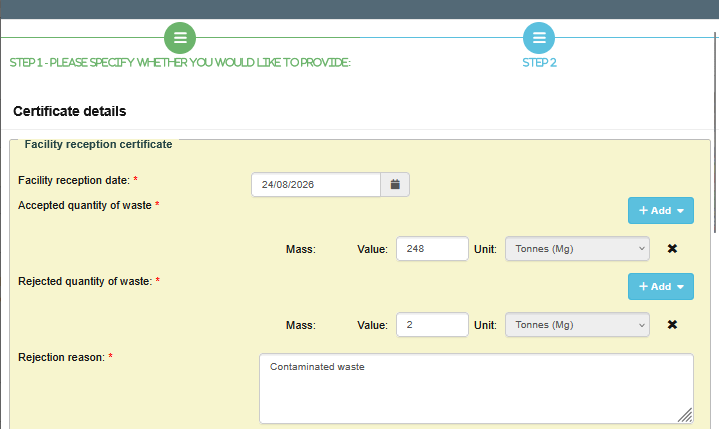
If nothing was rejected, enter 0 as the rejected quantity and “not applicable” as the reason. If the facility did not carry out one of the operations, it enters 0. Fields are not left empty.
Most common mistakes
Too little notice
Effect: the system blocks today and tomorrow; the law requires 2 full working days.
A company not in DIWASS
Effect: it cannot be selected and the document cannot be completed.
Changes after the producer has signed
Effect: the signature is removed and must be given again.
Wrong country or arranger
Effect: cannot be corrected – a new document is needed.
Unlabelled attachment
Effect: the carrier will not see it.
Empty fields in certificates
Effect: the facility’s confirmation is incomplete.
R12 or R13 without the next facility
Effect: information required by Annex VII is missing.
Frequently asked questions
Is DIWASS already mandatory for Annex VII?
The Annex VII module has been live in the production version of DIWASS since 15 November 2026. The European Commission has suggested extending the transition period so that digital Annex VII documents would become mandatory only from a date after 1 January 2027, and will set out the timeline after discussing this with the Member States. Status as at 24 November 2026.
How far in advance must the Annex VII document be submitted?
No later than two working days before the shipment starts (Article 18(5) of Regulation 2024/1157). DIWASS will not accept a departure date on the day of submission or the next day.
Can the document be corrected after submission?
Only three items: the quantity of waste, the carrier(s) and the container number – and only until the shipment starts. Everything else is locked. For a serious mistake, the arranger can cancel the document while it is in Draft or Announced status.
Who signs the document before submission?
The person who arranges the shipment and every waste producer named in the document. A signature in DIWASS is an authentication: the person enters their role in the company and confirms.
What does the carrier do in DIWASS?
It confirms taking over the waste: the date and the means of transport. With several carriers, each confirms its own leg. Whether a driver or a dispatcher does this in the system is a matter of internal organisation.
Do companies in Great Britain need to be registered in DIWASS?
To be selectable in a DIWASS document, any operator must be registered in DIWASS, even if it never logs in. Using the system is voluntary for companies outside the EU. Northern Ireland operators use DIWASS, because the EU Waste Shipment Regulation applies there under the Windsor Framework.
Is registration in DIWASS a waste transport permit?
No. DIWASS is used to exchange documents. Authorisations to transport waste in the countries on the route are separate obligations.